
Choosing a press on nails manufacturer affects more than unit cost. It determines whether approved colors can be repeated, whether custom designs can be sampled accurately, and whether packaging arrives ready for your sales channel. Before placing an OEM, private label, or wholesale order, buyers should verify five areas: production capability, customization limits, sample approval, quality control, and order planning.
Catalog photos and a low quotation do not show how a supplier handles revisions, batch consistency, or pre-shipment inspection. The checks below help beauty brands, wholesalers, distributors, importers, and salon suppliers compare manufacturers using evidence rather than general promises.
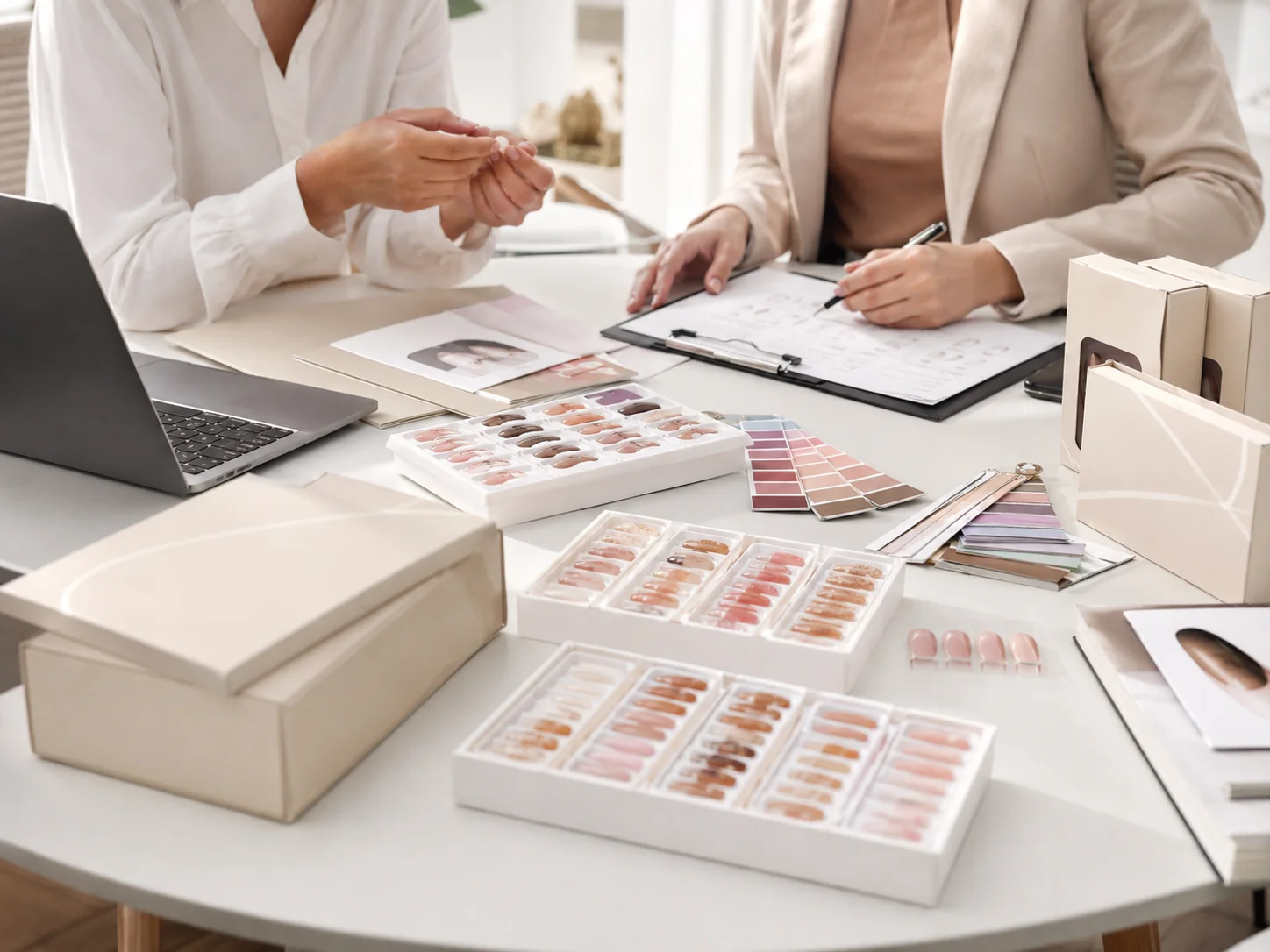
Quick Answer A reliable press on nails manufacturer should be able to explain where production takes place, what can and cannot be customized, how sample revisions are recorded, which quality checkpoints are used, and how MOQ and lead time are calculated for your project. Ask for verifiable production information, written sample specifications, inspection evidence, and a clear production plan before confirming a bulk order.
Comparing manufacturers for your next collection? Send AIERFEI a reference image or a brief description and your estimated order quantity. If you are still deciding on styles or packaging, tell us what is undecided so we can discuss the options.
In This GuideExpand or collapse
- 1. Verify Production Experience and Capability
- 2. Review Customization Capability
- 3. Check the Sample Development Process
- 4. Review Quality Control Procedures
- 5. Compare MOQ, Lead Time, and Production Planning
- 6. Supplier Comparison Checklist
- 7. How AIERFEI Supports Supplier Evaluation
- 8. Frequently Asked Questions
1. Verify Production Experience and Capability
Start by confirming whether the supplier has direct experience producing press-on nails, not only general beauty products. Press-on nail projects involve shape consistency, size combinations, surface finishing, decoration placement, color control, packaging protection, and repeat-order matching. A supplier should be able to explain how these processes are handled rather than simply saying that all production is possible.
Ask where molding, coloring, decoration, inspection, and packaging take place. If the supplier claims in-house production, request a live video walkthrough or recent production images that show the relevant areas. If part of the work is outsourced, ask which steps are subcontracted, who controls the specification, and who is responsible when the bulk order differs from the approved sample.
Factory age alone does not prove suitability. More useful questions concern the types of projects the team has handled: private label launches, wholesale collections, custom packaging, repeat orders, multiple-style programs, and export documentation. A team familiar with these projects should be able to identify missing information in your inquiry and explain which decisions must be made before sampling.
Repeat-order control is especially important. Ask how approved colors, materials, shapes, decoration methods, size charts, and packaging details are retained after the first production run. The supplier should also explain what happens if the original material or decoration component becomes unavailable and how any substitution is approved.
Questions to Ask About Production Capability
- Which production and packaging steps are completed in your own facility?
- Who manages sample approval and bulk production specifications?
- How are approved colors, materials, sizes, and packaging details recorded for repeat orders?
- How do you schedule repeat orders during peak production periods?
- Can you show a recent example of your inspection or sample-record process without revealing another customer's confidential information?
Evidence to Request From a Potential Supplier
| Area to Verify | Evidence to Request | Warning Sign |
|---|---|---|
| Production | A live walkthrough or recent images showing production, inspection, and packaging areas | Only catalog images are provided and the production owner is unclear |
| Sampling | A written specification, version record, and approval process | Design feedback is handled only through informal messages |
| Quality Control | Inspection checkpoints, defect-handling steps, and pre-shipment inspection options | The supplier only says that quality is strictly controlled |
| Repeat Orders | Approved samples, color references, material specifications, and packaging records | The supplier cannot explain how previous specifications are retained |
2. Review Customization Capability
Customization should be reviewed before price because each option can affect sampling work, production methods, inspection requirements, packaging structure, MOQ, and lead time. A capable custom press on nails supplier should explain the available options and the limitations attached to them.
- Shapes: coffin, almond, square, oval, stiletto, and other available profiles, with consistent sizing across sets
- Lengths: short, medium, long, and extra-long options for different product lines and market positions
- Colors: matching against a physical reference, approved color sample, or agreed color standard
- Finishes: glossy, matte, shimmer, pearl, chrome, cat eye, and other available effects
- Nail Art: French variations, gradients, printing, hand-painted details, and 3D decorations where technically suitable
- Packaging: boxes, sleeves, inserts, trays, instruction cards, labels, barcodes, and logo application for private label projects
The important question is not whether the supplier says “yes,” but how the request will be produced and controlled. Some decorations require more manual work. Some finishes are more sensitive to color variation. Packaging windows, inserts, and accessories can affect both presentation and transit protection. These details should be discussed before the quotation is treated as final.
A practical test is to choose one reference design and ask the supplier to break it down into material, shape, color process, decoration steps, finish, likely revision points, quality checkpoints, and packaging requirements. Compare this explanation with the sample quotation and written specification. If the process description changes each time you ask, the project may not yet be fully understood.
For private label press on nails , product and packaging development should be planned together. The nail size arrangement, accessory placement, insert dimensions, window position, and logo area all need to work within the final package rather than being added after the product is complete.
3. Check the Sample Development Process
Sampling shows how the supplier records specifications, responds to design feedback, and controls changes between versions. For custom colors, decoration placement, size combinations, or packaging, the initial sample may require revision before it can become the production reference.
Step 1: Confirm the Product Specification
Provide reference images, preferred shapes and lengths, color references, size requirements, estimated quantity, number of styles, packaging requirements, logo files, target market, and delivery destination. The supplier should reply with technical questions or a written specification summary. A simple order confirmation is not enough for a custom project.
Step 2: Produce the Initial Sample
The supplier produces the first sample based on the confirmed information. Sample cost and timing depend on the design, materials, decoration, packaging, and required revisions, so complex projects should not be treated as if every sample follows the same fixed process.
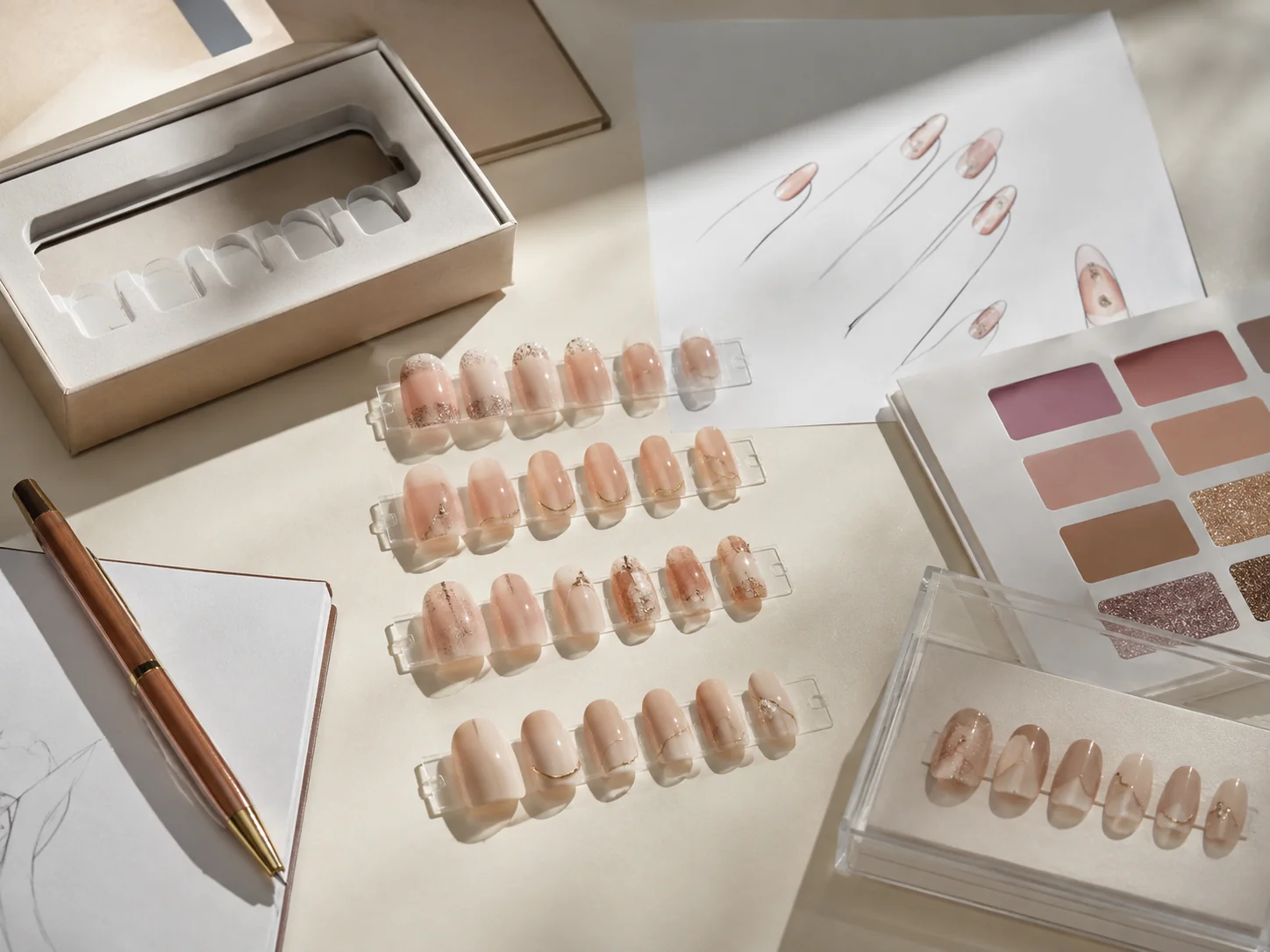
Step 3: Record and Review Revisions
Feedback should be specific and written. Instead of saying that the color is not right, identify whether it is too warm, too dark, too transparent, or inconsistent with the approved reference. Each revised version should be labeled so the buyer and supplier are discussing the same sample.
Before sampling begins, clarify how revision costs are handled, which changes are included, and whether packaging revisions follow a separate schedule. This avoids confusion when the product sample is approved but the box, insert, or label still requires adjustment.
Step 4: Approve the Bulk Production Reference
The final approved sample should become the reference for bulk production and inspection. Keep a sealed reference set and a copy of the final written specification. Approval should cover the nail design, color, finish, size arrangement, decorations, packaging, accessories, labels, and any agreed tolerances.
4. Review Quality Control Procedures
Quality control should be evaluated by inspection stages, acceptance criteria, records, and corrective actions—not by a general claim of “strict QC.” Buyers should ask which checks are performed during production, before packaging, and before shipment.
- Material Consistency: thickness, flexibility, surface behavior, and visible material variation
- Size Accuracy: included sizes checked against the approved size chart and set arrangement
- Color Matching: bulk color compared with the approved sample under agreed lighting conditions
- Surface Quality: bubbles, dust, streaks, scratches, uneven coating, or visible glue marks
- Decoration Placement: position, symmetry, adhesion, and consistency across pieces
- Packaging Inspection: correct products, accessories, inserts, labels, barcodes, and transit protection

Two questions reveal whether the supplier has a usable system. First, ask at which production stages inspection takes place and what happens to pieces that do not meet the standard. Second, ask whether the supplier can support a pre-shipment inspection against the approved sample and written specification.
For larger or higher-risk orders, buyers may use an independent inspection company or an agreed sampling plan. The important point is to define the inspection basis before production. If the acceptance standard is discussed only after the goods are finished, both sides may be working from different expectations.
If an on-site visit is not practical, request a live video walkthrough, time-stamped production photos, sample inspection records, or the option to arrange an independent inspection. Customer names, confidential designs, and private order details should be excluded from any evidence shared.
5. Compare MOQ, Lead Time, and Production Planning
MOQ is not a single number that applies to every press-on nail project. It can change according to the number of styles, customization level, color process, decoration, packaging, accessories, and total order structure. A useful quotation should explain which parts of the project are driving the MOQ rather than presenting one number without context.
Orders spread across many low-volume styles usually require more setup, sampling, color matching, and packaging work than a smaller number of styles with deeper quantity. Ask the supplier to separate the effects of style count, product customization, packaging customization, and total quantity when explaining unit cost and order requirements.
Lead time should also be broken into stages where possible: specification confirmation, sample development, revision, packaging proofing, material preparation, production, inspection, and shipping preparation. This makes it easier to identify which decisions are delaying the project and whether the planned launch date is realistic.
For an initial cooperation, buyers can limit the number of styles and confirm a test-order structure that still reflects the intended bulk process. The purpose is to evaluate specification control, communication, sampling, inspection, packaging, and delivery performance before expanding the program.
Communication is part of production planning. During the inquiry stage, notice whether replies address your actual questions, whether technical issues are explained clearly, and whether one person is responsible for coordinating the project. Slow or vague communication before an order often becomes more difficult once sampling and production begin.
6. Supplier Comparison Checklist
Use the following checklist when comparing quotations from more than one supplier. A lower unit price may not represent a lower total sourcing cost if sample revisions, packaging development, inspection, replacements, or delayed delivery are handled differently.
Tick each point as you review quotations, samples, and supplier evidence.
7. How AIERFEI Supports Supplier Evaluation
You can use the same checklist to evaluate AIERFEI or any other supplier you are considering. When reviewing an OEM, wholesale, or private label project, ask us to explain the proposed sampling route, specification records, packaging requirements, quality checkpoints, MOQ assumptions, and production plan before you compare quotations.
AIERFEI supports B2B press-on nail projects from reference review and sample development through packaging confirmation, bulk production, and inspection. You can review our wholesale press on nails collections , private label solutions , and factory and manufacturing information before contacting the team.
Start with a reference image or product idea and an estimated quantity. Include your target market if known. Shapes, finishes, packaging, and logo requirements can be discussed as the project develops; the specifications and quotation scope should be confirmed before sampling or production is approved.
8. Frequently Asked Questions
What should I look for in a press on nails manufacturer?
Focus on five areas: direct production capability, customization limits, a documented sample process, defined quality-control procedures, and clear explanations of MOQ and lead time. Ask for evidence that supports each claim rather than relying only on catalog images or general promises.
How can buyers verify whether a supplier is a factory or a trading company?
Ask who owns and manages production, where molding, decoration, inspection, and packaging take place, and who is responsible for sample approval and quality claims. Request a live video walkthrough or verifiable production information rather than relying only on website images.
Can a manufacturer create custom press-on nail designs?
Manufacturers with appropriate OEM capability can develop custom shapes, colors, finishes, decorations, and packaging from buyer references. The project should move through specification confirmation, sampling, written revisions, and final approval before bulk production.
What customization options are available for private label press on nails?
Options may include shapes, lengths, colors, finishes, nail art, size arrangements, packaging, inserts, labels, barcodes, accessories, and logo application. Available options depend on the factory's processes, the design, order structure, and packaging requirements.
How should wholesale buyers evaluate press-on nail samples?
Check the accuracy and consistency of all included sizes against the approved size chart. Compare color, surface finish, decoration placement, adhesion, packaging fit, and accessories with the written specification. Keep the approved sample as the reference for bulk inspection.
What information should buyers prepare before contacting a manufacturer?
Start with a reference image or product idea and an estimated order quantity. Add your target market and preferred delivery timing if known. You do not need a finished packaging design to begin the conversation; identify any undecided details so the manufacturer can help clarify the options.
Send Your Project for a Manufacturing Review
Send a reference image or describe the nails you want, together with your estimated quantity. If you have not chosen the packaging or finalized every style, you can still start an inquiry. We can discuss the customization and sampling requirements, then confirm the details needed for a project-specific quotation.
You can also contact the manufacturing team at sales@aierfeinails.com or through WhatsApp at +86 198 7629 6272.